SpaceX’s IPO highlights how leading technology companies are staying private for longer, with much of their value created before they reach public markets. As growth increasingly shifts into private markets, venture secondaries are becoming an important route for investors seeking pre-IPO access to established companies across artificial intelligence, space, defence technology, automation and advanced software. However, limited availability, privately negotiated transactions and valuation risk mean manager access, sourcing networks, investment discipline and careful selection remain critical.
SpaceX’s listing marks a shift that has been building for years: many of the world’s most important companies now grow and mature while still private.
The scale of the IPO was striking. SpaceX priced its shares at $135, raising $75bn and valuing the business at around $1.77tn before trading began. The shares rose sharply on debut, pushing the company’s valuation above $2tn and showing strong demand for market leading companies1.
But the bigger story is what happened before the IPO. By the time SpaceX went public, its business, technology and market position were already well established. Most of the value had been created while it was still private, and only a small group of investors had the chance to invest during that period.
Growth now happens before the IPO
SpaceX is not just a public markets story. It also shows how much value can now be created before a company lists. For today’s leading companies, the IPO is often no longer the main point of value creation. Instead, it marks the moment when the wider market gains access to a business that has already built its technology, scale and market position while private.
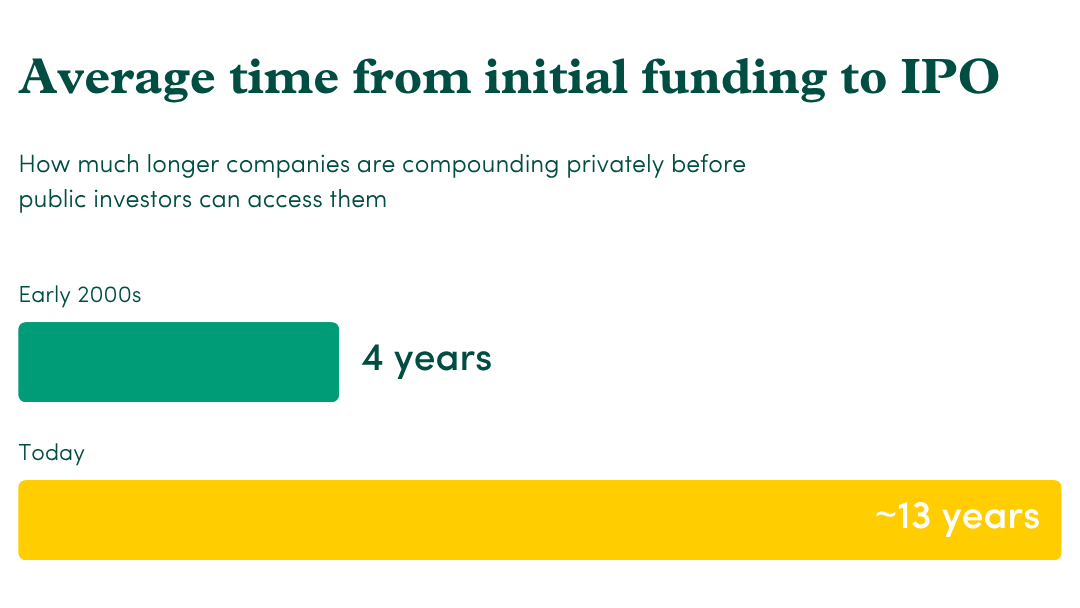
In the early 2000s, many successful technology companies listed much earlier in their development, giving public market investors a greater share of the growth journey. Today, the strongest companies are often remaining private for far longer. Recent market analysis suggests the average time from first funding to IPO has risen to around 13 years, compared with roughly four years in the early 2000s2.
That matters because the years before an IPO are now when much of the potential value is created. Companies aim to build products, win customers, grow revenue and strengthen their market position while still private. Artificial intelligence has accelerated this dynamic. Companies at the centre of the AI ecosystem can move from emerging technology to strategic necessity at extraordinary speed, while the same pattern is visible across parts of space, defence technology, automation and advanced software Anthropic’ confidential IPO filing suggests the next generation of public technology companies will also spend years building value in private markets before they list3.
Why pre-IPO access is difficult
For investors, this creates a clear challenge. Believing in the long-term growth of AI, space, automation or frontier software is one thing. Gaining exposure to the companies already becoming leaders in those fields is quite another.
The most sought-after private businesses often have little need to raise new capital. Existing investors have the resources to keep backing them, boards are selective about new shareholders, and founders are careful about who they let in. As a result, even when investor demand is high, access remains limited.
Secondaries are opening the door
This is why the venture secondary market has become so significant. Secondary transactions allow existing shareholders in private companies, including early investors, employees, founders or venture funds, to sell shares before a company goes public. In a market where companies are staying private for longer, that liquidity has become more important.
The market has grown to meet that demand. PitchBook estimates that US venture secondary transaction value reached $106.3bn in 2025, bringing secondaries closer to the scale of more traditional venture exit routes4. This is not just a response to a temporarily quieter IPO market. It reflects a lasting change in how private companies are owned, traded and funded. For investors, late-stage venture secondaries can offer another way to invest in private companies. They do not remove risk: private company valuations can move materially including downwards, exit timelines can change, and advanced-stage technology businesses remain exposed to competition, regulation and execution risk. The attraction lies instead in the entry point.
The advantage is that investors are buying into companies that have already proven much more. Unlike early-stage venture, where investors back ideas with uncertain outcomes, late-stage secondaries focus on businesses with established products, growing customers, strong financial backing and a clearer path to an eventual exit.
Access is only part of the story
Getting that access to the best potential opportunities is not easy. The most attractive late-stage companies are rarely available through a broad, open market. Secondary opportunities are often privately negotiated, relationship-driven and dependent on the confidence of founders, boards and existing shareholders.
This places a premium on manager quality. In venture secondaries, capital alone is rarely enough. The ability to originate opportunities, assess company quality, understand ownership networks, negotiate access and execute reliably can determine whether investors reach the companies they want to own.
It also places a premium on selectivity. A well-known company name can attract attention, but it does not remove the need to assess valuation, growth quality, competitive position, governance and exit potential. In a market shaped by scarcity, there is always a risk that investors focus too heavily on access itself and too lightly on the terms on which that access is being offered.
The best opportunities combine access with careful selection: identifying advanced-stage companies where leadership is already emerging, where the business has moved beyond the most uncertain phase of development, and where there remains a credible path to potential further value creation.
Capturing growth before the opening bell
SpaceX is an exceptional example, but it illustrates the wider point. By the time it went public, it had already proven its value. Most investors only had the chance to invest after much of its growth had already happened.
That pattern is likely to repeat. Many of tomorrow’s leading companies may be recognised long before they list. By the time they reach public markets, a significant share of their value may already have been created.
For private investors, this does not mean chasing every pre-IPO opportunity or treating late-stage venture as a simple route to public market upside. It is about recognising that more growth now can happen while companies are still private. The rise of the secondary market is creating new ways to access that growth, but the best potential opportunities are still typically concentrated among managers with the right relationships, experience and investment discipline.
As leading technology companies stay private for longer, access before the IPO is becoming an increasingly important part of long-term investing.
Important note
Investments in private companies can be illiquid, valuations may be uncertain, capital is at risk and there is no guarantee that anticipated exits or investment outcomes will be achieved. SpaceX is an exceptional case and should not be regarded as representative of typical venture-backed companies or a guarantee of investment outcomes.
This article is provided for general information purposes only. It does not constitute investment research, investment advice, a recommendation, or an invitation to invest in any fund, security or investment opportunity.
Sources
- Reuters, “Elon Musk-led SpaceX’s first week as a public company sparks market mania”, 22 June 2026.
- StepStone Group, “Finding alpha in a shifting return landscape”, 2 February 2026; citing PitchBook data as of July 2025.
- Anthropic, “Anthropic confidentially submits draft S-1 to the SEC”, 1 June 2026.
- PitchBook, 2025 Annual US VC Secondary Market Watch, February 2026.